Mia Otto · 18 September 2026
The Evolution of Coastal Habitat Restoration Through Community Partnerships
Coastal habitat restoration has shifted over decades from top-down government initiatives to collaborative models that integrate local communities with scientific organizations and agencies, and data from multiple regions shows this transition accelerated after the 1970s when environmental regulations began emphasizing public involvement in marine ecosystem recovery. Researchers tracked restoration projects across North America, Europe, and Australia to document how partnerships formed around shared goals like stabilizing shorelines, rebuilding fish populations, and reducing erosion through native species replanting. According to records maintained by the National Oceanic and Atmospheric Administration, community-led efforts in the United States alone contributed to over 2 million acres of coastal wetlands being addressed between 1990 and 2025, with local groups handling planting, monitoring, and maintenance tasks that government crews previously managed alone.
Early Approaches and Initial Shifts
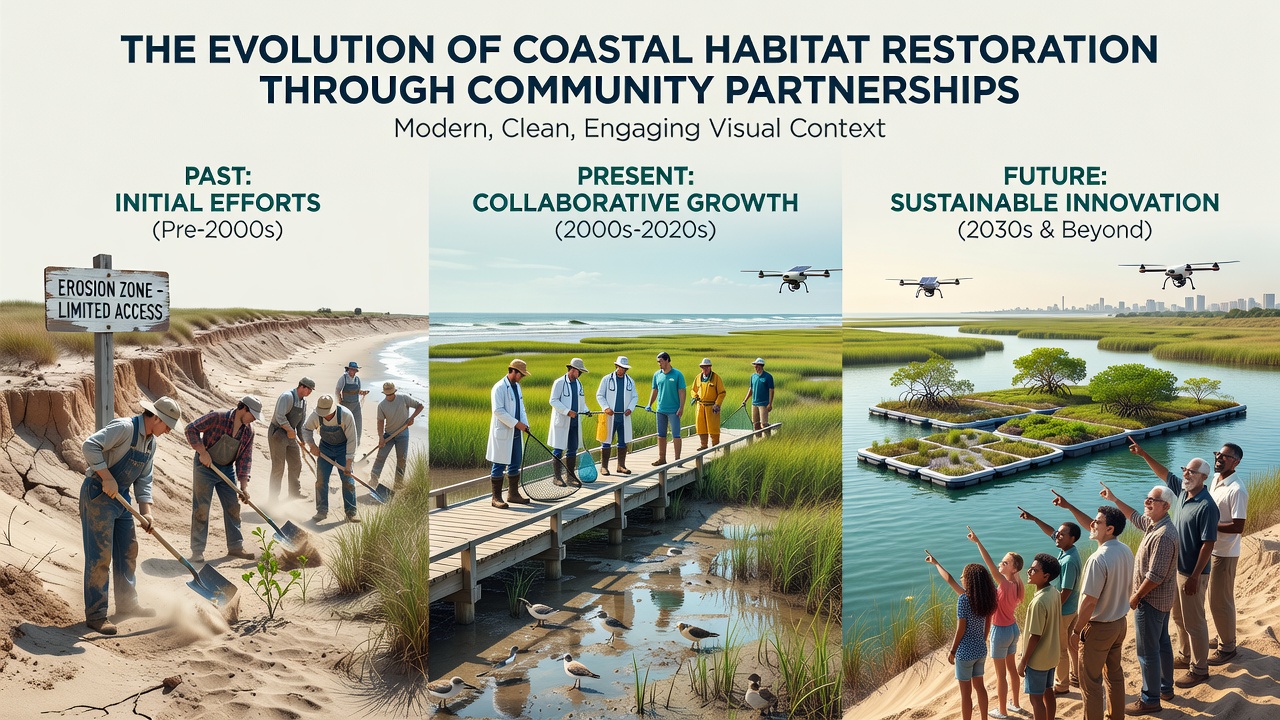
Government agencies dominated coastal projects in the mid-20th century, focusing on engineering solutions such as seawalls and dredging, while community roles remained limited to occasional volunteer labor, yet by the 1980s regulatory changes encouraged broader participation because agencies recognized that sustained success required ongoing local stewardship. Studies from the period indicate that isolated restoration attempts often failed due to lack of maintenance after initial funding ended, and partnerships emerged as a practical response when groups in places like the Chesapeake Bay formed alliances with universities to monitor water quality and replant seagrass beds. Those early collaborations demonstrated measurable improvements in habitat function, with data indicating higher survival rates for restored areas when residents took ownership of follow-up activities.
Growth of Partnerships in the 21st Century
Expansion of community partnerships gained momentum after 2000 as international frameworks like the Ramsar Convention on Wetlands promoted inclusive approaches, and coastal communities in Australia began working with federal agencies to restore mangrove forests damaged by development, while similar models appeared along European shores where citizen science programs tracked biodiversity recovery. Reports compiled by the Australian Government Department of Climate Change, Energy, the Environment and Water highlight that partnership projects in Queensland and Western Australia restored thousands of hectares of saltmarsh and seagrass between 2010 and 2025, with local volunteers contributing labor equivalent to millions of dollars annually. These efforts combined traditional knowledge from Indigenous groups with modern techniques such as drone mapping and genetic analysis of plant stock, creating hybrid methods that improved project longevity.
Key Methods and Tools Employed
Restoration teams now rely on a combination of hands-on planting, artificial structures like oyster reefs, and monitoring technologies that communities help operate, and active voice descriptions in project reports detail how volunteers install biodegradable erosion barriers while scientists analyze sediment samples for nutrient levels. Data indicates that sites managed through partnerships show 30 to 50 percent better long-term vegetation cover compared with purely agency-run sites, according to longitudinal studies conducted across multiple climates. Training programs teach participants to identify invasive species, collect water samples, and use simple apps for real-time reporting, which reduces response times when problems arise such as sudden algal blooms or storm damage.
Regional Examples and Measurable Outcomes
In the Gulf of Mexico, partnerships between fishing communities and research institutions have rebuilt oyster habitats that support both commercial harvests and wave attenuation, while along the Baltic Sea, Nordic countries coordinate with local municipalities to address eutrophication through reed bed restoration and nutrient runoff controls. Canadian Atlantic provinces report similar patterns where Indigenous-led initiatives combine with federal funding to replant kelp forests, and metrics collected through these networks show increases in fish biomass and bird nesting activity within three to five years of project start. Observers note that cross-border exchanges allow techniques proven in one area to transfer efficiently, such as the use of floating nurseries that originated in Southeast Asia and now appear in temperate restoration sites.
Developments Scheduled for September 2026
Preparations continue for the September 2026 International Coastal Restoration Symposium, where representatives from partnership networks will present updated datasets on project scalability and climate resilience, and organizers expect discussions to focus on integrating satellite monitoring with ground-level community observations to refine adaptive management strategies. Funding announcements tied to that event are projected to support expanded training modules for new regions entering restoration work, building on existing models that already link economic benefits like tourism revenue to habitat health. Records from prior symposia indicate that such gatherings accelerate knowledge sharing, leading to standardized protocols adopted across continents within two years of presentation.
Conclusion
Coastal habitat restoration through community partnerships has evolved into a structured system supported by data collection, cross-regional learning, and integrated funding streams, and evidence from government reports and academic monitoring programs confirms that these collaborations deliver measurable ecological returns while distributing responsibility beyond single agencies. Future projects will likely build on the frameworks established through decades of incremental adaptation, incorporating new technologies and broader participation to address ongoing pressures from sea level rise and development.